St. Johns County Property Appraiser Search 2026
From the ancient, cobblestone streets of historic St. Augustine to the massive new master-planned neighborhoods in Nocatee, St. Johns County has one of the most complex real estate markets in Florida.
Buying a home on the coast in Ponte Vedra comes with totally different tax rules and zoning laws than buying a historic property downtown.
You cannot trust basic real estate websites to give you the exact numbers. To get the truth, you must look at the official public data.
Below, I will show you exactly how to use the tools provided by Property Appraiser Eddie Creamer to find hidden property details, view interactive maps, and legally lower your tax bill.
St. Johns County Property Appraiser Property Search
If you are buying a house in St. Johns County or checking the public record of a home you already own, the basic property search is your starting point.
What to Do: You need to search the official county database. You can find properties using the physical address, the owner’s name, or the Parcel ID Number.
How to Do It (Step-by-Step):
-
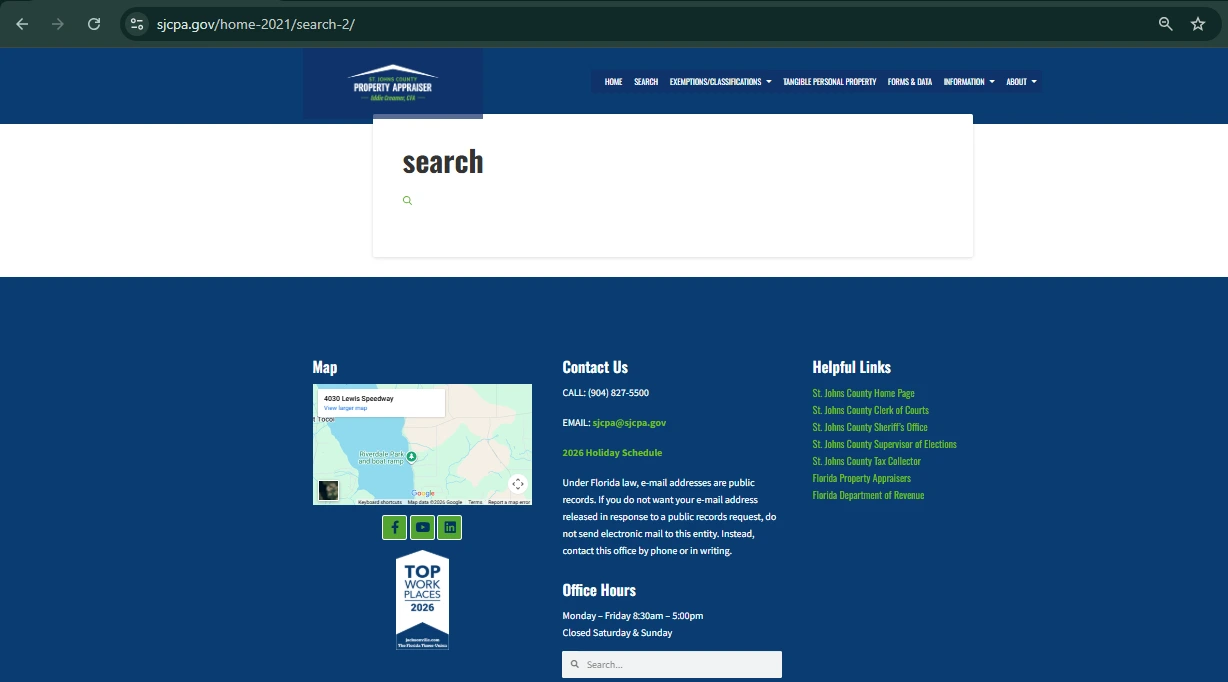
Open the Portal: Go directly to the official St. Johns County Property Appraiser Search.
-
Choose Your Search Method: Select the option to search by “Property Address,” “Owner Name,” or “Parcel ID.”
-
Type the Address Simply: When you type a street address, do not use full words like “Street,” “Avenue,” or “Boulevard.” Use short forms like “ST,” “AVE,” or “BLVD” so the system does not give you an error.
-
Search by Owner Name: Always type the owner’s Last Name first, leave a space, and then type the First Name (Example: Smith John).
-
Open the Property Card: Click on the correct property in the list. This opens the full file showing the assessed value, total square footage, and past sales history.
Expert Local Insight: St. Johns County is home to huge planned communities like Nocatee and Julington Creek. When looking at a property card for a home in these areas, always check the “Non-Ad Valorem Assessments” section.
This is where you will find the CDD Fee (Community Development District fee). CDD fees pay for the neighborhood waterparks, gyms, and roads, but they are added directly to your property tax bill.
Many out-of-state buyers are shocked when their tax bill is thousands of dollars higher than they expected because they did not check this section!
St. Johns County FL GIS Map Search
Reading text records will not tell you if a house is sitting near a fragile beach dune. To see property boundary lines, zoning rules, and nearby water areas, you must use the visual map tool.
What to Do: You will use the county’s Geographic Information System (GIS) tool, called iMap. This places colorful data layers directly over real aerial satellite photos of the neighborhood.
How to Do It (Step-by-Step):
-
Open the Map Tool: Click over to the St. Johns County iMap.
-
Find the Property: Use the search bar in the top corner to type the property address or the Parcel ID.
-
Open the Layer Menu: Click the “Layers” icon on the side of your screen.
-
Turn on Flood Zones: Check the box for “Flood Zone Viewer” to see if your mortgage bank will force you to buy expensive flood insurance.
-
Check Historic and Coastal Layers: Turn on the specific local layers to see exactly what building limits apply to the land.
Expert Local Insight: If you are buying a home in Ponte Vedra Beach or St. Augustine Beach, you must open the map layers and turn on the “Coastal Construction Control Line” (CCCL) and “Wind-Borne Debris Regions.”
If the home you want to buy crosses the CCCL, getting government permits to build a simple wooden deck or a swimming pool is incredibly strict and expensive.
Knowing this boundary line before you buy will save you a massive headache later.
St. Johns County Homestead Exemption
If you own a home in St. Johns County and live there as your permanent, primary residence, you are losing money if you do not file for a Homestead Exemption.
This simple online form drops your property’s taxable value by up to $50,000 and puts a strict legal cap on how much your taxes can go up each year.
What to Do: You must file your application with the Property Appraiser before the absolute legal deadline of March 1st. Once approved, it renews automatically every year as long as you do not move.
How to Do It (Step-by-Step):
-
Update Your Florida IDs: Before applying, your Florida Driver’s License and Florida Vehicle Registration must clearly show your new St. Johns County address.
-
Go to the E-File Page: Visit the SJCPA Exemptions Portal and click to file online.
-
Start the Application: You will need your Social Security Number and your Parcel ID to begin.
-
Upload Your Proof: The system will ask you to attach clear photos of your updated driver’s license and vehicle registration.
-
Save Your Confirmation: Always write down your tracking receipt number or save the confirmation email before you close the webpage.
Expert Local Insight: Are you moving from another home in Florida to a new house in St. Augustine or Nocatee? You must ask for “Portability” during your application.
Portability lets you transfer your old “Save Our Homes” tax savings to your new property. If you forget to check the Portability box on the form, you will lose those savings forever.
St. Johns County Property Tax Bill Search
Eddie Creamer and his team decide how much your house is worth, but his office does not touch your money.
The St. Johns County Tax Collector (Dennis W. Hollingsworth) is the elected official who actually collects your payment.
What to Do: You need to use the official Tax Collector website to view your actual tax bill, check for late fees, or pay online.
How to Do It (Step-by-Step):
-
Go to the Tax Collector: Open the secure St. Johns County Tax Payment Site.
-
Search Your Account: Type in your property address, owner name, or Parcel ID.
-
View the Bill: The system will show your exact tax amount owed.
-
Pay Online: You can print a PDF copy of your bill or pay it instantly using a credit card or an eCheck.
Expert Local Insight: Property tax bills are mailed out every year on November 1st. If you pay your bill in November, you get a 4% discount.
The discount goes down every month. If you wait until March 31st, you get zero discount. Always pay in November to keep more cash in your pocket.
St. Johns County Local Offices & Contact Details
If the online system is broken, or if your name is spelled wrong on the public record, do not waste time guessing. It is always faster to call or visit a real person. Here are the exact local offices you need.
1. St. Johns County Property Appraiser (Main Office)
-
What they do: Go here to fix record errors, ask deep valuation questions, or file your exemptions in person.
-
Physical Address: 4030 Lewis Speedway, Suite 203, St. Augustine, FL 32084
-
Working Phone Number: 904-827-5500
-
Website Link: sjcpa.gov
2. St. Johns County Tax Collector (Main Office)
-
What they do: Call this office only when you are ready to pay your tax bill or if you have questions about a late payment penalty.
-
Physical Address: 4030 Lewis Speedway, St. Augustine, FL 32084
-
Working Phone Number: 904-209-2250
-
Website Link: sjctax.us
3. Tax Collector (Ponte Vedra Branch)
-
What they do: Offers the exact same tax payment services, but much easier to visit if you live in the northern coastal area.
-
Physical Address: 151 Sawgrass Corners Drive, Suite 100, Ponte Vedra Beach, FL 32082
-
Working Phone Number: 904-209-2250 (Routes to main call center)
Frequently Asked Questions (FAQ)
What is a Parcel ID in St. Johns County?
Yes, a Parcel ID is a long, unique number assigned to every single piece of property in St. Johns County. It is the fastest and most accurate way to search for your tax records on the official portal.
You can find it on your TRIM notice.
How do I apply for a Homestead Exemption in St. Johns County?
You can easily apply online using the St. Johns County Property Appraiser website. You must submit your application before March 1st.
Make sure your Florida Driver’s License and vehicle registration match your new home address before you start the digital form.
When are property taxes due in St. Johns County?
Property tax bills are mailed out every year on November 1st. You receive a 4% discount if you pay your bill in November.
The final, absolute deadline to pay your taxes without getting hit with heavy late penalties is March 31st.
Why did my property taxes go up after buying a house?
When you buy a property, the county resets the tax value to match the current real estate market. The previous owner likely had an exemption that kept their taxes artificially low for many years.
Your new bill is simply based on your higher purchase price.