Search Pinellas property records, Parcel ID, GIS maps, homestead, tax bills, TRIM and storm value tools
If you are checking a Clearwater home, St. Petersburg condo, beach parcel, manufactured home, LLC-owned rental, tax bill or storm-damage value issue, start with the official PCPAO property card. Copy the Parcel ID first, then use it for map search, homestead e-file, Tax Collector bills, TRIM review, FEMA 50% value and VAB.
Pinellas County property research is not only about finding one record. Coastal homes, condo towers, manufactured homes, storm-damaged parcels, rental properties and redevelopment areas often need more careful checking than a simple owner-name search.
This guide is built for practical use. It tells you which official link to open, why that link matters, what to do after opening it, what details to copy, and which office to contact before you pay, file homestead, report damage, request a correction or submit a VAB petition.
What do you need from the Pinellas County Property Appraiser?
Start with your task, not the office name. This prevents wrong-office confusion and saves time.
Find a property card
Use Quick Search for owner, address, Parcel ID, Sub/Condo, sales, values, exemptions, tax district and last deed details.
After opening: search with a simple address first, then save the Parcel ID.
Go to search stepsCheck parcel lines or map
Use map search for parcel shape, nearby parcels, sales layer, measure tool, map style and coastal context.
After opening: use Parcel ID if the address gives several results.
Go to map stepsApply for homestead
Use the official PCPAO e-file tool. Prepare residency documents before filing because March 1 is the key deadline.
After opening: confirm ownership appears in your name before completing the application.
Go to homestead sectionView or pay tax bill
Use the Tax Collector, not the Property Appraiser. PCPAO values property but does not collect payments.
After opening: verify Parcel ID, tax year, owner and discount period before paying.
Go to tax bill sectionReview TRIM or appeal value
Use your TRIM notice, property card and evidence before filing VAB.
After opening: call the appraiser first if the issue may be corrected informally.
Go to TRIM/VAB sectionCheck storm or FEMA value
Use PCPAO storm damage and FEMA 50%/49% value resources before rebuild, repair or appeal steps.
After opening: save photos, repair estimates, insurance documents and permit details.
Go to storm sectionProperty Appraiser vs Tax Collector vs Clerk/VAB in Pinellas County
Many users lose time because they ask the wrong office. Use this quick routing table first.
Use for records, values, maps and exemptions
Use PCPAO for property card search, owner details, Parcel ID, market value, assessed value, taxable value, homestead, portability, TRIM, map search, storm value and property-detail corrections.
After opening: search the property and save the Parcel ID before moving to tax, map or VAB tools.
Use for bill, payment and receipt
Use the Tax Collector for property tax bill, online payment, tax receipt, escrow questions, discount periods, installment plan and delinquent status.
After opening: confirm tax year, Parcel ID, owner and amount before paying.
Use for deeds and formal disputes
Use the Clerk for official records such as deeds, mortgages and liens. Use VAB if a value, exemption or classification dispute is not resolved after informal review.
After opening: choose deed/recording search or VAB petition based on your issue.
Pinellas local tools and initiatives users should not miss
PCPAO has more than a basic property search. These tools are useful for real Pinellas issues like coastal parcels, hurricanes, manufactured homes, homestead, senior exemptions, property sales, redevelopment and public records.
| Official tool | Why use it | What to do after opening |
|---|---|---|
| Quick Search | Find property card, Parcel ID, owner, values, exemptions, sales, tax district and map link. | Search address first, then copy Parcel ID. |
| Map Search | Review parcel location, nearby parcels, sales layer, measure tool and map style. | Use Parcel ID for exact map matching. |
| Homestead E-File | File homestead and personal exemptions through the official PCPAO workflow. | Wait for deed processing, prepare residency proof and save confirmation. |
| TRIM Guide | Understand proposed value, exemptions, tax district and estimated taxes before the bill. | Compare TRIM with your property card quickly. |
| Storm Damage Resources | Important for hurricane, flood, wind or calamity damage in coastal Pinellas. | Save photos, insurance papers, estimates and permits. |
| FEMA 50% / 49% Value | Useful for substantial damage/improvement, rebuilding and permit planning. | Find building value, then confirm permit/floodplain rules separately. |
| Official Records | Use the Clerk for deeds, liens, mortgages and recorded documents. | Search by name, instrument, book/page or recording details. |
How to search Pinellas property records by address, owner, Parcel ID or Sub/Condo
Use PCPAO Quick Search when you need the official property card. The search screen supports Address, Owner, Parcel ID and Sub/Condo, so you can start broad and then narrow down to the correct parcel.
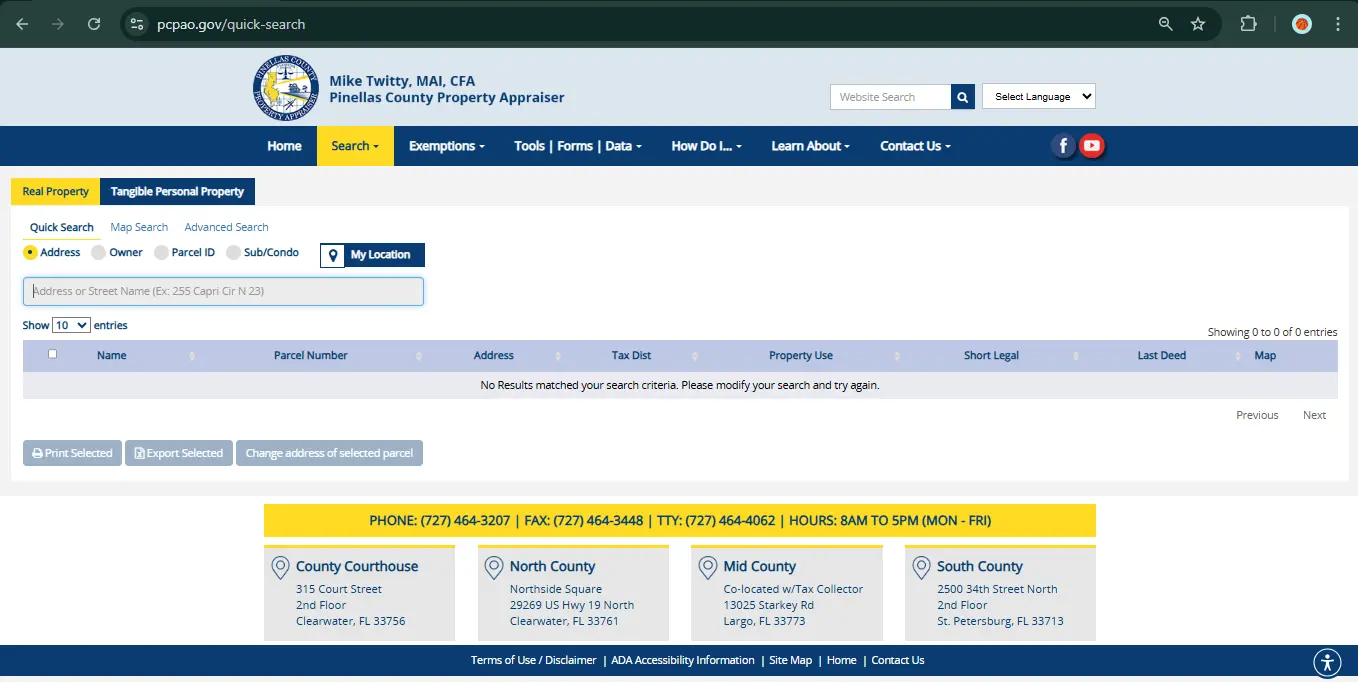
Open official PCPAO Quick Search
Start here when you need current property-card details. Avoid using copied third-party pages for final decisions.
After opening: choose Address, Owner, Parcel ID or Sub/Condo based on what you already know.
Open PCPAO Quick SearchSearch with the cleanest detail first
Use Address for normal lookup, Owner for a person or company, Parcel ID for exact match, and Sub/Condo for condo buildings or subdivisions.
Why: Pinellas has many condos, beach properties, common names and LLC-owned parcels, so one search method may show too many results.
If no result appears, remove extra words
Try house number plus main street name only. Remove apartment/unit number, punctuation, street suffix, direction words and extra address text.
Example: try “315 Court” before typing a long full address.
Open the matching property card
Confirm owner, site address, mailing address, Parcel Number, tax district, property use, short legal, last deed, sale history, values and exemptions.
Stop if: owner, Parcel ID or site address does not match. Do not pay, file or appeal using a doubtful record.
Pinellas search tricks that save time
| Search situation | Use this trick | Why it works |
|---|---|---|
| Condo or beach unit | Search the building address first, then compare unit and Parcel ID. | Unit formatting can vary between records. |
| LLC or trust owner | Try address or Parcel ID if the owner-name search is messy. | Business names may include abbreviations, punctuation or legal suffixes. |
| Mobile or manufactured home | Check whether the record is real property, mobile home or another account type. | Manufactured-home situations may be handled differently. |
| Sale price looks too low | Open deed details or sale type before comparing value. | Some transfers are not normal market sales. |
| Old owner still appears | Check deed processing and ownership-change timing. | Public record updates may take time after closing. |
Copy this before leaving the property card
Pinellas Parcel ID: the number to copy before using another portal
The Parcel ID is the most reliable way to connect the same property across PCPAO search, map search, Tax Collector account lookup, homestead e-file, TRIM notice, deed research and VAB petition.
| Where Parcel ID helps | Why it matters | What to do next |
|---|---|---|
| Quick Search | Avoids address-format and owner-name confusion. | Copy it exactly from the official property card. |
| Map Search | Finds the exact parcel when map/address search shows multiple results. | Paste Parcel ID into map search if available. |
| Tax Collector | Helps match the correct tax bill and account. | Compare Parcel ID before paying. |
| Homestead | Connects the exemption filing to the correct property. | Keep it with your e-file confirmation. |
| TRIM / VAB | Evidence and petitions must match the property. | Match Parcel ID with your TRIM notice. |
Pinellas County map search, parcel lines, sales layer and coastal checks
Map search is very important in Pinellas because many properties are close to beaches, bays, canals, flood-prone areas, redevelopment corridors and dense condo zones.
Open PCPAO Map Search
Use map search after you already have a Parcel ID or clean property address.
After opening: search by name, address, STRAP or parcel, then zoom into the selected property.
Open PCPAO Map SearchUse sales and measure tools carefully
The map page includes tools such as selected parcel view, sales, measure, full map and map style. These are useful for research and comparison.
Why: nearby sales and parcel shape can help you understand value context, but they are not a formal appraisal by themselves.
Do not treat map lines as a legal survey
For fence, setback, easement, dock, encroachment, coastal construction or closing issues, confirm with a survey, title company, building department or official records.
How to read the Pinellas property card correctly
The property card is not just one value number. Each field answers a different question.
| Property card field | What it means | What to do if it looks wrong |
|---|---|---|
| Parcel Number / Parcel ID | Main identifier used across search, maps, tax bills, TRIM and VAB. | Copy it before paying, filing or calling. |
| Owner name | Owner of record based on recorded information. | Check deed, trust, probate, LLC or ownership update timing. |
| Site address | Physical location of the property. | Compare with map search and short legal description. |
| Mailing address | Address used for notices and tax-related mail. | Use official mailing-address change process if wrong. |
| Tax district | Taxing area connected to the property. | Compare with TRIM notice and tax bill. |
| Property use | How the property is categorized for appraisal purposes. | Prepare photos, permits or use proof if incorrect. |
| Last deed | Recent deed reference connected to Clerk records. | Use Clerk official records for deed details. |
Pinellas homestead exemption, Save Our Homes and portability preparation
Use the official PCPAO e-file page for homestead. The key deadline is March 1 following the year of purchase, and the property must be your permanent residence as of January 1. New buyers should also allow time for deed/ownership processing before filing.
Before opening the e-file link, prepare this
Why use this link: it is the official route to file Pinellas homestead and related personal exemptions. Do not use unofficial forms for final filing.
After opening: confirm the property shows ownership in your name, enter residency details, upload or provide documents if requested, and save the confirmation.
Pinellas property tax bill, payment, discounts and delinquent date
The Property Appraiser values property, but the Tax Collector handles the tax bill. Use the Tax Collector when you need to view, print, pay, confirm escrow, check discounts or verify delinquent status.
| Payment timing | Typical status | User action |
|---|---|---|
| November | Highest early-payment discount period. | Confirm you are not escrowed before paying yourself. |
| December | Discount still available, but lower than November. | Check current tax amount before paying. |
| January | Lower discount period. | Check processing time if paying by bank or mail. |
| February | Final discount period. | Do not wait if mail delay is possible. |
| March 31 | Deadline before delinquent status. | Pay by deadline to avoid penalty and interest. |
| April 1 | Unpaid taxes generally become delinquent. | Contact the Tax Collector quickly if unpaid. |
Why use this link: the Tax Collector page is the correct source for bills, payments, receipts, discount periods, installment plans and delinquent taxes.
After opening: search the account, confirm Parcel ID, property address, owner, tax year, discount period, escrow note and payment fee before submitting payment.
Pinellas TRIM notice, value review and VAB petition steps
Your TRIM notice is the best time to review market value, assessed value, taxable value, exemptions, tax district and proposed taxes. If something looks wrong, contact PCPAO quickly before jumping directly to VAB.
Review TRIM against your property card
Compare value fields, property use, building data, exemptions, owner name, tax district and Parcel ID.
After opening: note the deadline shown on your TRIM notice.
Open PCPAO TRIM GuideAsk for informal review first
Discuss the concern with PCPAO before filing VAB. This can help explain the value or correct a record issue.
Why: some problems are data or explanation issues, not formal appeal issues.
File VAB only if still unresolved
Use VAB when value, exemption or classification concerns remain unresolved after review.
After opening: select the correct petition type, prepare evidence and verify the deadline.
Open Pinellas VAB PortalEvidence that usually helps
| Issue | Evidence to collect | How to explain it |
|---|---|---|
| Market value too high | Comparable sales, appraisal, condition photos, repair estimates. | Show why the value is not market value as of January 1. |
| Building data wrong | Photos, permits, floor plan, demolition or repair proof. | Point to the exact wrong field on the property card. |
| Homestead missing | E-file confirmation, ID, residency proof, ownership documents. | Ask whether the issue is eligibility, processing or missing document. |
| Storm damage not reflected | Damage photos, insurance documents, repair estimates, FEMA/permit notes. | Show condition existed for the relevant value period. |
| Classification or use issue | Use records, lease, business documents, photos or correspondence. | Explain why the property use/classification should differ. |
Pinellas storm damage, FEMA 50% value and calamity-related property help
This is a high-priority Pinellas topic because coastal, beach, bay, canal and low-elevation properties may face damage, repair, floodplain and permitting questions after storms.
| Situation | Why PCPAO resource helps | What to do after opening |
|---|---|---|
| Storm or hurricane damage | PCPAO has property damage information and resources. | Save photos, insurance reports, contractor estimates and permit records. |
| FEMA 50% / 49% value question | Building value may matter for substantial damage or improvement review. | Find the FEMA value, then confirm permitting/floodplain rules with the correct building department. |
| Repair or rebuild planning | Property value and building value can affect the review conversation. | Do not rely only on the appraisal record; check permits separately. |
| Calamity tax refund question | Some catastrophic event situations may require official forms and evidence. | Keep dates, photos, insurance documents and occupancy/repair proof. |
Change mailing address, name, deed, survey or property details
If your mailing address, owner name, deed reference, survey issue or structural detail looks wrong, start with the property card and choose the correct correction path.
Open the current property card
Check owner, mailing address, site address, Parcel ID, tax district, property use and last deed.
Open Quick SearchChoose the correct correction type
Mailing address, name change, owner death, deed issue, survey, parcel split/combine and structural detail updates may require different proof.
After opening: follow the exact document instructions and save confirmation.
Open Changes, Questions or RequestsUse the Clerk for official recorded documents
PCPAO may show deed references, but the Clerk is the official source for recorded deeds, liens, mortgages and other official records.
Open Clerk Official RecordsPinellas property scenarios: what to check first
Use the closest situation below before calling an office.
Beach or waterfront owner
Check Parcel ID, map, FEMA value, flood/permit context, storm damage records, insurance documents and tax bill separately.
Condo owner
Search Sub/Condo or building address first, then confirm unit, Parcel ID, value, exemption and tax account.
New buyer
Compare sale price, tax district, seller’s exemptions, future taxable value, escrow and deed processing timing.
Manufactured home owner
Check whether the record is real property or another account type before comparing bills or values.
Rental or LLC owner
Verify owner name, mailing address, use code, tangible property exposure and Tax Collector account carefully.
Appeal user
Collect TRIM, property card, photos, comparable sales, repair estimates, storm documents and exact field errors.
Pinellas County Property Appraiser phone number, offices and map
Before calling, have the Parcel ID, property address, owner name, screenshot and a one-sentence issue summary ready. This helps staff route your question faster.
| Office or service | Contact / location | Use for |
|---|---|---|
| Property Appraiser main phone | 727-464-3207 Fax 727-464-3448 TTY 727-464-4062 |
Records, values, exemptions, TRIM and maps. |
| County Courthouse | 315 Court Street, 2nd Floor, Clearwater, FL 33756 | Main office and in-person property help. |
| North County | Northside Square, 29269 US Hwy 19 North, Clearwater, FL 33761 | North Pinellas owner and exemption help. |
| Mid County | 13025 Starkey Road, Largo, FL 33773 | Largo/mid-county help, co-located with Tax Collector. |
| South County | 2500 34th Street North, 2nd Floor, St. Petersburg, FL 33713 | St. Petersburg and South Pinellas property help. |
| Tax Collector | 727-464-7777 | Tax bill, payment, receipt and delinquent tax questions. |
Pinellas County Property Appraiser – Clearwater Office
315 Court Street, 2nd Floor, Clearwater, FL 33756
Pinellas Property Appraiser call or email script
Use this helper before contacting PCPAO, Tax Collector, Clerk or VAB. A short and exact message usually gets better routing.
Official Pinellas County property sources used in this guide
Use official pages for final action because portals, deadlines, forms, payment fees, storm resources and office details can change.
Property Appraiser
Main official office site for property records, values, exemptions, maps and TRIM help.
After opening: use the menu for Search, Exemptions, Tools/Forms/Data and How Do I pages.
Open PCPAOQuick Search
Search by address, owner, Parcel ID or Sub/Condo and open the property card.
After opening: copy Parcel ID and verify owner/address.
Search RecordsMap Search
Use for parcel location, sales layer, measuring, larger map and map style tools.
After opening: search by Parcel ID or clean address.
Open MapHomestead E-File
Use for homestead and personal exemption filing.
After opening: confirm ownership, January 1 residence and documents.
E-File HomesteadTRIM Guide
Use to understand proposed property taxes, values and exemptions.
After opening: compare your TRIM notice with your property card.
TRIM GuideVAB Petition
Use when informal review does not solve value or exemption issues.
After opening: prepare evidence and watch the deadline.
Open VABStorm Damage
Use for storm, hurricane, calamity and property damage resources.
After opening: gather photos, estimates, insurance and permit proof.
Storm ResourcesFEMA 50% / 49%
Use for building value questions tied to substantial damage or improvement review.
After opening: confirm permitting/floodplain rules separately.
FEMA ValueTax Collector
Use for tax bill, payment, receipt, discounts and delinquent tax.
After opening: verify Parcel ID and tax year before paying.
Tax CollectorRelated: Hillsborough
Helpful for Tampa-area property search, exemptions and tax-record routing.
After opening: compare office routing and property search steps.
Open Hillsborough GuideRelated: Pasco
Useful for Pasco property records, homestead and parcel search help.
After opening: compare nearby county records and tax-routing steps.
Open Pasco GuideFlorida directory
Use the homepage to find other county property appraiser guides.
After opening: search or browse for the county you need.
Open DirectoryPinellas County Property Appraiser FAQs
How do I search Pinellas County Property Appraiser records online?
Open the official PCPAO Quick Search page and search by Address, Owner, Parcel ID or Sub/Condo. Address is easiest for most users, while Parcel ID is best when you need an exact property match.
What is the official Pinellas County Property Appraiser website?
The official Pinellas County Property Appraiser website is pcpao.gov. Use it for Quick Search, Map Search, homestead e-file, TRIM help, forms, property data, storm damage resources and contact information.
What is a Parcel ID in Pinellas County?
A Parcel ID, sometimes shown as Parcel Number, is the property identifier used to connect the property card with maps, tax bills, homestead e-file, TRIM notice, official records and VAB petitions.
Can I search Pinellas property records by owner name?
Yes. Use the Owner search option in PCPAO Quick Search. For common names, trusts, LLCs or company names, verify the site address, mailing address, Parcel ID, tax district and last deed before relying on the result.
Where do I apply for Pinellas County homestead exemption?
Use the official PCPAO eFile Homestead Exemption page. The property should reflect ownership in your name, and the home must be your permanent residence as of January 1 for the tax year.
What is the Pinellas homestead exemption deadline?
The key deadline for homestead and many personal exemptions is March 1 following the year of purchase. New owners should allow time for the deed to process and should prepare residency documents before filing.
Where do I pay Pinellas County property taxes?
Pinellas County property taxes are handled by the Pinellas County Tax Collector, not the Property Appraiser. Use the Tax Collector property tax page or county tax account search to view, print, pay or verify a bill.
Can I use the PCPAO map as legal boundary proof?
No. PCPAO map search is useful for parcel research, sales layers, measuring and map context, but legal boundary, easement, fence, dock, setback and closing questions may require a survey, title review or official legal records.
How do I dispute my Pinellas property value?
Review the TRIM notice, compare it with the property card, collect evidence, contact PCPAO for informal review first, and file a VAB petition only if the issue is not resolved before the deadline.
What is the Pinellas County 2026 VAB petition deadline?
The Pinellas VAB petition portal currently lists September 11, 2026 as the petition deadline. Always verify the live deadline on the official VAB portal and on your TRIM notice before filing.
Best way to use Pinellas County property records
For most users, the safest workflow is simple: open PCPAO Quick Search, find the property card, copy the Parcel ID, use map search only for research, use PCPAO for exemptions/TRIM/value/storm questions, use the Tax Collector for bills and payments, and use the Clerk/VAB only when official records or formal petitions are needed.