Search Miami-Dade property records, folio numbers, GIS maps, homestead, tax bills and VAB steps
If you are checking a Miami-Dade home, condo, rental, LLC-owned parcel or tax bill, do not start randomly. Start with the official property card, copy the 13-digit folio, then use that same folio for GIS, homestead, TRIM, tax bill and appeal tasks.
Miami-Dade property research is not hard when you know the correct order. The Property Appraiser helps with the property record, folio, value, exemptions, TRIM and property information. The Tax Collector handles the real tax bill and payment. The Value Adjustment Board handles formal disputes. GIS is useful for maps, but it is not a legal survey.
This guide is written for people who want to finish a task, not read a government manual. You will see what link to open, what to do after opening it, why that link matters, and what mistake to avoid before you pay, apply, appeal or call.
What do you need from Miami-Dade property records?
Pick your task first. This avoids opening five different county pages when you only need one.
Find a property record
Use the official property search to find the property card, owner, site address, folio, values, exemptions and sales.
After opening: search with address first, then copy the folio.
Go to property search stepsUnderstand value or exemption
Use the property card, value fields and exemption status before assuming your tax bill is wrong.
After opening: compare market value, assessed value and taxable value.
Go to value helpPay or verify tax bill
Use the Tax Collector. The Property Appraiser does not collect your property taxes.
After opening: match the folio before making payment.
Go to tax bill sectionApply for homestead
Use the official exemption page or online filing tool. Prepare proof before applying.
After opening: use folio, ownership proof and Florida residency documents.
Go to homestead sectionAppeal value or denial
Use TRIM and VAB only when you need a formal value, exemption, classification or portability dispute.
After opening: save the deadline and prepare evidence.
Go to VAB sectionFix owner or mailing data
Use the official property information change route. Do not rely on copied third-party records.
After opening: compare owner, mailing address and recorded deed details.
Go to correction sectionMiami-Dade Property Appraiser vs Tax Collector vs VAB
This one section can save you the most time. Open the right office based on your exact problem.
Use for records, values, folio and exemptions
Use this for property card search, owner record, folio number, site address, mailing address, market value, assessed value, taxable value, exemptions, TRIM questions and property data corrections.
After opening: search the property and save the folio before moving to another tool.
Use for tax bill, payment and receipt
Use this for the actual tax bill, online payment, mail payment, receipt, delinquent status, returned payment and payment support.
After opening: verify the folio and tax year before you pay.
Use for formal appeal petitions
Use this for value disputes, exemption denial, classification disputes, portability issues and VAB hearing information.
After opening: check filing fee, deadline, petition type and evidence rules.
Miami-Dade online tools and local initiatives worth using
Miami-Dade has several useful online tools beyond simple property search. These are helpful when you want to understand the full property-tax picture.
| Official tool | Why use it | What to do after opening |
|---|---|---|
| Property Search | Find ownership, folio, sales, values, exemptions, aerial imagery and map features. | Search by address or folio, then save the property card details. |
| Property Search Help | Explains search behavior, folio search and multiple-result issues. | Use it when address/name search gives wrong or too many results. |
| Folio Numbers | Explains the 13-digit parcel identifier used across Miami-Dade property systems. | Learn how to recognize and use the folio correctly. |
| Tax Visualizer | Helps users understand how property taxes are distributed across taxing authorities. | Use it after reviewing your TRIM or tax bill to understand where taxes go. |
| Tax Estimator | Helps estimate possible taxes and understand homestead-related benefits. | Use it before buying, moving or comparing exemption impact. |
| Online TRIM Notice | Shows proposed values, exemptions, proposed taxes and appeal-related timing. | Download your notice and save the VAB deadline. |
| Exemption Application Status | Helps check whether your exemption filing is moving correctly. | Use your confirmation/folio and verify before tax season. |
How to search Miami-Dade property records by address, owner, folio or subdivision
The official property search is the first page most users need. It can show property characteristics, ownership, sales, assessments, exemptions, taxable value, aerial imagery, building sketches when available and map features.
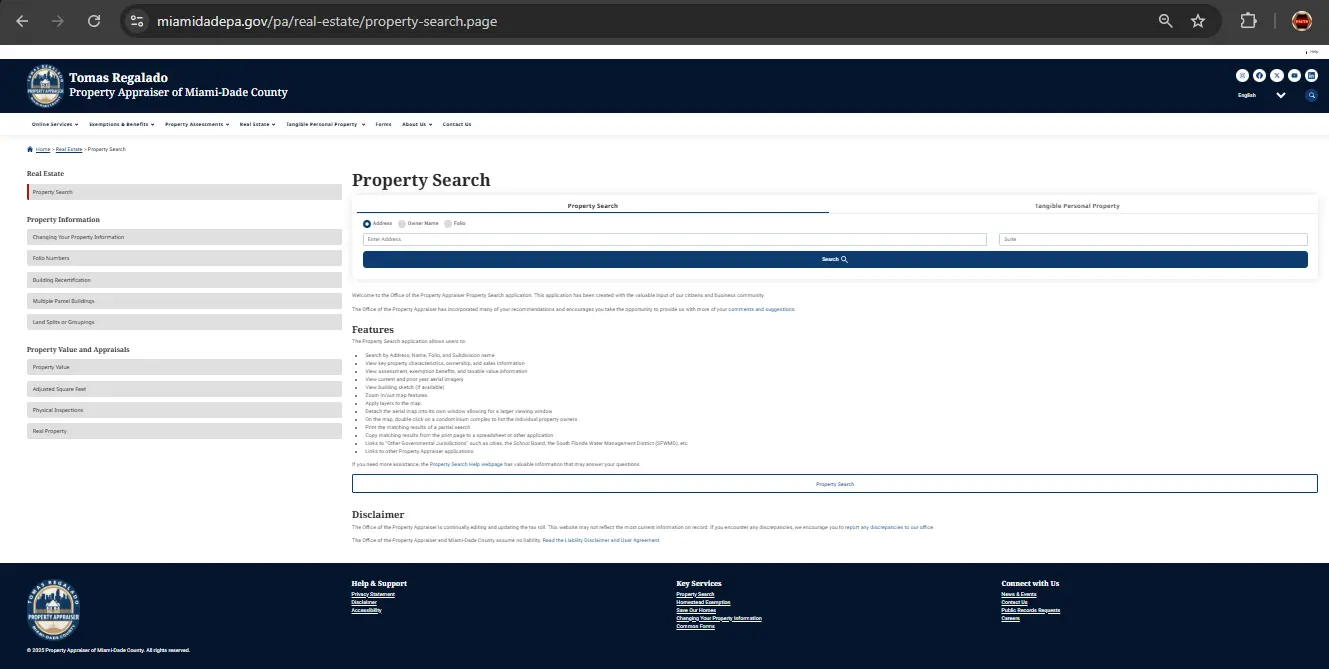
Open the official property search first
Start here when you need a property card. Do not begin with a third-party directory if you need current official assessment data.
After opening: choose address, owner name, folio or subdivision search.
Open official Miami-Dade Property SearchUse the easiest search first
For a normal home, start with address. For an exact parcel, use folio. For an LLC, company or trust, owner search may work but can be messy.
Why this matters: the wrong search method can show similar properties and waste your time.
Search with less, not more
If nothing shows, remove unit number, punctuation, direction, street suffix and extra address words. Try house number plus main street name only.
Example: try “123 Biscayne” before entering the full long address.
Open the property card and verify it
Check folio, owner, site address, mailing address, legal description, sales, exemptions and values before using the record for taxes or appeals.
Stop here if: owner/address/folio does not match. Do not pay or file using a doubtful record.
Real Miami-Dade search tricks that save time
| Search situation | Use this trick | Why it works |
|---|---|---|
| Condo unit not showing | Search the building address first, then compare unit and folio. | Unit formatting can differ between portals. |
| LLC or trust owner search fails | Search by address or folio instead of full legal entity name. | Company names may include punctuation, abbreviations or suffixes. |
| Miami Beach gives many results | Use folio or exact site address after finding likely matches. | Dense condo buildings produce many similar records. |
| New buyer still sees old owner | Check deed/ownership update timing before assuming an error. | Recorded documents and appraisal records may update at different times. |
| Address has NW, NE, Street or Avenue | Remove direction and suffix first, then add them only if needed. | Simpler input often catches more matches. |
Copy these details before leaving the property card
Miami-Dade folio number: the 13-digit ID you should save first
The folio number is the key to Miami-Dade property research. It is a 13-digit parcel identifier used by computer systems to associate records with one property.
| Where folio helps | Why it matters | What to do after finding it |
|---|---|---|
| Property search | Avoids spelling and address-format errors. | Copy it from the official property card. |
| GIS map | Helps locate the exact parcel when address search is unclear. | Paste it into map tools when available. |
| Tax bill | Helps match the Tax Collector account to the correct property. | Compare folio before paying. |
| Homestead | Exemption filing must match the correct parcel. | Keep folio with application confirmation. |
| TRIM / VAB | Notices and petitions are tied to a specific parcel. | Match folio with TRIM notice before filing. |
How to read the Miami-Dade property card correctly
The property card is not the tax bill. It is the official assessment record. Read it field by field.
| Property card field | What it means | What to do if it looks wrong |
|---|---|---|
| Folio | Unique parcel identifier used across Miami-Dade systems. | Compare with tax bill, GIS and TRIM notice. |
| Owner name | Owner of record shown by the Property Appraiser. | Check deed, trust, probate or ownership-change timing. |
| Mailing address | Address used for official notices and property mail. | Use official change information process if wrong. |
| Site address | Physical property location for search and mapping. | Compare with GIS and legal description. |
| Building details | Property characteristics used in appraisal review. | Prepare photos, permits, sketches or correction proof. |
| Exemptions | Benefits applied to reduce taxable value when eligible. | Check homestead or benefit status if missing. |
Market value, assessed value and taxable value in simple language
A high tax bill does not always mean the Property Appraiser made one simple mistake. You must separate market value, assessed value, taxable value, exemptions and tax rates.
Market value
The Property Appraiser’s estimate of property value as of the valuation date. Start here if you believe the value is too high.
Assessed value
The value after limits or caps. Homesteaded properties may have assessed value lower than market value.
Taxable value
The value after exemptions. The final tax bill also depends on millage rates and non-ad valorem charges.
| What looks wrong | Possible reason | What to check next |
|---|---|---|
| Market value jumped | Sales market, property data or condition assumption changed. | Compare similar sales and condition proof. |
| Assessed value is lower than market | Assessment cap or Save Our Homes benefit may apply. | Review exemption and portability status. |
| Taxable value increased | Exemption, cap or ownership change may be involved. | Review homestead and ownership history. |
| Bill still seems too high | Tax rates or non-ad valorem charges may be part of the bill. | Review the Tax Collector bill line by line. |
Miami-Dade GIS and Land Information Viewer: use it correctly
GIS is useful for visual research. It helps you see parcel location, aerial imagery, nearby properties and map context. It is not a legal survey.
Open GIS after you have the folio
Use the folio or clean property address from the property card for better map matching.
After opening: search the folio, then zoom to the parcel and compare nearby properties.
Open Miami-Dade Land Information ViewerUse layers as research, not final proof
Look at aerial imagery, nearby parcels and property location. Use this as support, not legal evidence.
Confirm legal issues separately
For fence, setback, easement, encroachment, flood, zoning or closing problems, use a survey, title review, zoning office or recorded documents.
Miami-Dade homestead exemption: apply with the right proof
Homestead can reduce taxable value for eligible permanent residents. Miami-Dade also offers other exemptions and benefits, so do not stop at the first page if you may qualify for more.
Before opening the homestead link, prepare this
Why use the official homestead page: it explains eligibility, documents and the correct online application route. Do not rely on unofficial checklists for final filing.
Senior exemption, portability and other benefits people often miss
Some Miami-Dade owners qualify for more than basic homestead. These benefits can matter for seniors, disabled owners, veterans, surviving spouses and Florida homeowners moving from another homesteaded property.
| Benefit area | Who should check it | What to prepare |
|---|---|---|
| Senior exemption | Eligible seniors with homestead and income-based requirements. | Income, residency and homestead proof. |
| Portability | Florida homeowners moving from one homesteaded property to another. | Old folio, new folio and move details. |
| Veteran or disability exemption | Eligible veterans, disabled owners or surviving spouses. | Official benefit/disability documents. |
| Agricultural or land classification | Owners with qualifying land use or special classification. | Use proof, applications and supporting records. |
After opening the link: read the list of benefits first, then choose the exact exemption or reduction that matches your situation.
Review Miami-Dade Exemptions & BenefitsMiami-Dade property tax bill and payment: use the Tax Collector
The Tax Collector collects and distributes property taxes. The Property Appraiser does not collect your payment and does not set tax rates.
| Your need | Correct office | What to do after opening |
|---|---|---|
| View or pay property tax bill | Tax Collector | Search by folio/account, confirm tax year and owner, then pay. |
| Check why value changed | Property Appraiser | Review property card, TRIM notice and value fields. |
| Understand non-ad valorem charges | Tax Collector or levying authority | Read the bill line item; it may not be based on property value. |
| Payment receipt problem | Tax Collector | Save confirmation and contact payment support. |
| Mail payment | Tax Collector | Write folio and phone number on the check; do not mail cash. |
Miami-Dade TRIM notice: check this before your final tax bill
TRIM notices are sent to property owners by August 24. They include property values, exemption benefits, proposed taxes and budget hearing information.
TRIM checklist
After opening the TRIM link: download or view the notice, save the deadline, compare value fields and decide whether informal review or VAB is needed.
Miami-Dade VAB: appeal only with clear evidence
The Value Adjustment Board handles formal disputes for proposed assessments. A normal VAB filing fee is listed as $15 per parcel, identified by folio number, with special lower-fee cases for some joint petitions.
Strong evidence examples
| Evidence type | What it supports | Practical user step |
|---|---|---|
| Comparable sales | Market value argument. | Use similar nearby sales around the valuation date. |
| Property condition photos | Damage, deferred maintenance or condition issue. | Use dated photos and explain each problem. |
| Repair estimates or invoices | Cost to correct condition problems. | Keep itemized contractor details. |
| Appraisal or closing statement | Independent value or transaction evidence. | Explain date and why it applies to the tax year. |
| Income and expense records | Income-property valuation issue. | Prepare rent roll, leases, vacancy and expenses. |
| Exemption proof | Homestead, portability, senior or other benefit dispute. | Prepare ID, residency, ownership and application proof. |
Insider VAB preparation tips
After opening VAB: select the correct petition type, confirm filing fee, save the filing deadline, upload evidence and keep confirmation.
Denied exemption, portability or classification: what to do next
If a benefit was denied, first identify why. The solution is different for missing proof, late filing, ownership issue, residency issue, portability issue or classification problem.
Find the exact denial reason
Check the notice or status message. Do not guess. Write down the exact missing item or reason.
Ask for informal review if it may solve the problem
If it looks like missing proof or a record issue, informal review may help. Still watch the VAB deadline.
File VAB on time if needed
Do not let an informal conversation make you miss the formal filing deadline.
Change owner, deed, mailing address or wrong property information
If owner name, mailing address or property data looks wrong, use the official correction route. Do not rely on old screenshots or third-party pages.
Compare the official property card first
Check owner, mailing address, site address, legal description, building details and folio number.
Open the official change information page
Use this route for property information changes instead of emailing random departments first.
After opening: select the correction type and follow the document instructions.
Open Changing Your Property InformationUse ownership-change contact when needed
For deed, ownership or mailing address changes, Miami-Dade lists OwnershipChanges@MiamiDadePA.gov.
Common Miami-Dade property search problems and quick fixes
Use this when the official record does not match what you expected.
| Problem | Likely cause | Best next step |
|---|---|---|
| Address search fails | Unit, suffix, direction or punctuation mismatch. | Search house number and main street only, then try folio. |
| Owner name looks old | Recent deed, trust, company, probate or processing delay. | Check recorded documents and ownership-change route. |
| Building data looks wrong | Property characteristics may need review. | Prepare photos, permits, sketches or documentation. |
| Homestead missing | Filing, residency, deadline or document issue. | Check exemption status and contact Exemptions if needed. |
| Tax bill higher than expected | Rates, non-ad valorem charges, exemption issue or payment timing. | Review the Tax Collector bill and TRIM notice separately. |
| GIS boundary looks wrong | GIS is only a map reference. | Use survey, title review or official records for legal boundaries. |
Miami-Dade Property Appraiser contacts and office map
Before calling or emailing, have your folio number, property address, owner name, screenshot and short issue summary ready. This helps staff route your question faster.
| Office or department | Contact | Use for |
|---|---|---|
| Property Appraiser Public Service | 305-375-4712 PAWebmail@MiamiDadePA.gov |
General property record, folio and exemption questions. |
| Ownership changes | OwnershipChanges@MiamiDadePA.gov | Deed, ownership or mailing address changes. |
| Tax Collector | 305-375-5448 support@mdctaxcollector.gov |
Property tax bill, receipt and payment questions. |
| Value Adjustment Board | 305-375-5641 | Formal value, exemption, classification and portability petitions. |
Main Property Appraiser Office
111 NW 1 Street, Suite 710, Miami, FL 33128-1984
Miami-Dade Property Appraiser call or email script
Use this helper before contacting the office. A short, exact message is easier to route than a long confusing email.
Official Miami-Dade property sources used in this guide
Use official pages for final action because deadlines, portal screens, fees, office hours and forms can change.
Property Appraiser
Main official office website for Miami-Dade property appraisal and exemptions.
Use it for: official entry point and department routing.
Open SiteProperty Search
Search by address, owner, folio or subdivision and review property details.
After opening: save folio and property card details.
Search RecordsSearch Help
Official help for folio, search behavior and multiple-result issues.
After opening: use it when search gives no result or too many results.
Search HelpFolio Numbers
Understand the 13-digit property identifier.
After opening: learn why folio is used across county tools.
Folio HelpGIS Viewer
Map, aerial and nearby parcel context.
After opening: search folio/address and compare map location.
Open GISHomestead
Review homestead exemption rules and apply online.
After opening: confirm eligibility and documents.
HomesteadTax Collector
Use for real estate tax bills, payments and receipts.
After opening: verify folio and tax year before payment.
Tax CollectorTRIM Notices
Review proposed values, exemptions and appeal deadline information.
After opening: download notice and save VAB deadline.
TRIM NoticesVAB
Formal appeal route for value, exemption, classification or portability disputes.
After opening: check petition type, fee, deadline and evidence rules.
Open VABMiami-Dade County Property Appraiser FAQs
How do I search Miami-Dade County Property Appraiser records online?
Open the official Miami-Dade Property Search page and search by address, owner name, folio number or subdivision. For most homeowners, address search is easiest. For exact parcel lookup, use the 13-digit folio number.
What is the official Miami-Dade County Property Appraiser search website?
The official search website is the Miami-Dade County Property Appraiser Property Search page. It lets users search by address, name, folio or subdivision and review ownership, characteristics, sales, assessments, exemptions and taxable value.
What is a Miami-Dade folio number?
A Miami-Dade folio number is a 13-digit property identifier, also called a parcel identifier. It connects the property card, GIS map, tax bill, homestead exemption record, TRIM notice and Value Adjustment Board petition.
Can I search Miami-Dade property records by owner name?
Yes. Use the owner name search option on the official property search page. For a person, try the last name first. For an LLC, trust or company, use the business name and confirm the address and folio before relying on the result.
Where do I apply for Miami-Dade homestead exemption?
Use the official Miami-Dade Property Appraiser Homestead Exemption page or the online exemption filing tool. Prepare your folio number, ownership proof and Florida residency documents before applying.
Where do I pay Miami-Dade property taxes?
Miami-Dade property tax payments are handled by the Miami-Dade Office of the Tax Collector, not the Property Appraiser. Use the Tax Collector real estate tax page or official tax bill portal to view, pay or verify property taxes.
Can Miami-Dade GIS maps be used as legal boundary proof?
No. Miami-Dade GIS maps are useful for parcel research, aerial imagery and nearby property context, but legal boundary, easement, fence, setback and closing questions may require a survey, title review or official recorded documents.
How do I appeal my Miami-Dade property value?
Review your TRIM notice, compare the property card, collect evidence, request informal review if helpful and file with the Miami-Dade Value Adjustment Board before the deadline listed on the notice.
Who handles Miami-Dade deed, ownership or mailing address changes?
Use the Miami-Dade Property Appraiser change information page for property information updates. Miami-Dade lists OwnershipChanges@MiamiDadePA.gov for deed, ownership and mailing address change questions.
What is the safest order to research a Miami-Dade property?
The safest order is to search the official property card, save the 13-digit folio, check GIS if needed, review exemptions, verify the tax bill with the Tax Collector and use VAB only if you need a formal value or exemption dispute.
Best way to use Miami-Dade property records
For most users, the best workflow is simple: search the official property card, save the folio number, use GIS only for map context, review exemptions, verify the tax bill with the Tax Collector and use VAB only when a formal dispute is needed.