Search Levy County property records, zoning layers and tax details without guessing
Use this page as a task guide. Search the parcel, read the property card, open map layers, check zoning and FEMA flood information, prepare homestead documents and confirm the correct office before you pay, file or call.
Start with the task you need
Find a property record
Use owner name, address or parcel number. Parcel number gives the cleanest result.
Read the property card
Check owner, mailing address, site address, land data, building data and value fields.
Check zoning and flood context
Levy County gives a practical map workflow for zoning and FEMA flood layers.
File homestead
Prepare deed, ID and residency proof before starting the exemption process.
Pay property taxes
Use the Tax Collector for tax bill lookup, payment methods, receipts and fees.
Fix record routing
Address changes for real property go to the Property Appraiser, not the Tax Collector.
Task finder
Select the issue and this tool gives the correct next step and official page.
Select an issue and click the button.
How to search Levy County property records
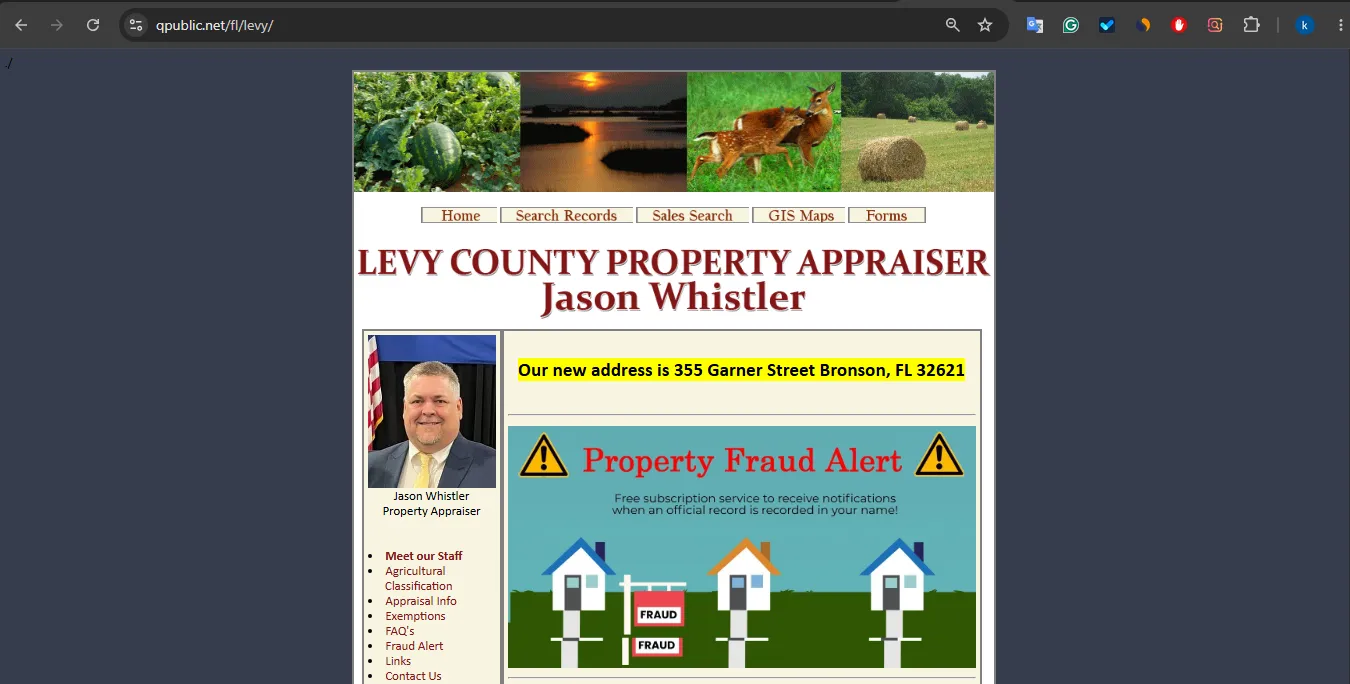
This is the best place to start if you need owner details, parcel data, site address, values, land data or a map link.
Property card decoder
| Field | What it means | Why it matters |
|---|---|---|
| Parcel number | Unique property identifier used across search, maps and tax-related lookup. | Use this in every official search, tax inquiry or record question. |
| Owner name | Owner of record based on recorded ownership information. | Check this before filing exemptions or researching a property. |
| Mailing address | Address used for notices and tax-related mail. | If it is wrong, fix it with the Property Appraiser to avoid missing notices. |
| Site address | Physical location for the parcel. | Use it to confirm the correct property and map view. |
| Land data | Lot size, land use or other land-related information used in valuation. | Useful for buyers, landowners and zoning research. |
| Building data | Improvement details such as square footage, year built or structure data. | Review this if the value looks wrong or if a structure was added or changed. |
| Market value | Appraiser’s estimate of market value. | This is the starting point for value review. |
| Assessed / taxable value | Value after caps and exemptions are applied. | These fields affect the actual taxable amount. |
Which value should you look at?
Market value
The appraiser’s estimate of value before assessment limits and exemptions.
Assessed value
The value after assessment caps such as Save Our Homes or other limits.
Exempt value
The amount reduced by homestead or other exemptions.
Taxable value
The value used to calculate ad valorem tax.
| If you notice this | It usually means | Best next step |
|---|---|---|
| Market value seems high | The property record or valuation basis may need review. | Compare the card details and check map, land and building data. |
| Assessed value is much lower than market value | Caps such as Save Our Homes may be helping. | Check homestead status before making ownership changes. |
| Taxable value still feels too high | Exemption may be missing or tax bill may include extra non-ad valorem charges. | Check both the property card and the tax bill. |
| Property taxes feel higher than expected | The bill may include non-ad valorem charges beyond value-based taxes. | Review the Tax Collector bill details, not only the appraiser record. |
Levy County zoning and FEMA flood layer workflow
This is one of the most useful local features for land buyers, property owners and anyone checking use restrictions or flood context.
Homestead exemption and Save Our Homes
Main use
Homestead is for your primary Florida residence, not for investment or second-home use.
Best filing habit
File early and keep your deed, ID and residency proof ready.
Before changing title
Ask first if you already have homestead or Save Our Homes protection.
Document checklist before you contact or file
- Recorded deed or ownership proof.
- Florida driver license or state ID with your current residence details.
- Residency-related documents that support primary-residence status.
- Parcel number and property address.
- Any existing homestead or prior Florida homestead information if portability questions apply.
| Situation | Risk point | Best action |
|---|---|---|
| New homeowner | Waiting too long to organize documents. | Prepare documents early and contact the Property Appraiser if unsure. |
| Title or ownership change | Homestead or assessment-cap effects may change. | Ask the Property Appraiser before recording major ownership changes. |
| Moving from another Florida home | You may overlook portability or prior homestead effects. | Ask about Save Our Homes portability timing and requirements. |
| Vacant land owner | Homestead does not apply the same way as an occupied primary residence. | Clarify eligibility before assuming exemption benefits. |
Tax bill payment and Levy Tax Collector fees
Property Appraiser handles
Property records, values, homestead-related record guidance and address-change routing.
Tax Collector handles
Property tax bill lookup, payment methods, online-payment fees and payment proof.
Address changes and office routing
| If your problem is | Correct office | What to do |
|---|---|---|
| Property record, owner, parcel, value or exemption question | Property Appraiser | Start with the Levy County Property Appraiser portal and office contact. |
| Tax bill payment, online payment or tax receipt | Tax Collector | Use the Tax Collector property-tax page. |
| Address change for real property account | Property Appraiser | Do not send it to the Tax Collector first. |
| Zoning or parcel-use research | County zoning resources plus the parcel map | Use the Levy County zoning map workflow and confirm what layer data shows. |
Scenario checklist
Land buyer
Check owner, parcel number, map, zoning layer, FEMA flood layer and tax bill before making assumptions.
Homeowner
Check mailing address, homestead, value fields and annual tax-bill details.
New Florida resident
Check homestead timing and Save Our Homes questions early.
Rural parcel user
Use parcel-number search, not just address search, and always review map context.
Taxpayer
Use the Tax Collector page for payment method, fees and receipt questions.
Research-heavy user
Do not stop at the parcel card. Also check zoning and flood layers if the parcel matters for building or land use.
Helpful video
This video is a general Florida education resource for property tax and homestead concepts. Use Levy County official pages for county-specific records, forms and final actions.
Levy County property owner timeline
Property Appraiser contact and map
| Office | Contact | Use for |
|---|---|---|
| Levy County Property Appraiser | 310 School Street, P.O. Box Drawer 100, Bronson, FL 32621 Phone: 352-486-5222 Fax: 352-486-5187 |
Property search, record review, value questions, exemption guidance and address-change routing. |
| Levy County Tax Collector | Official office directory and service pages | Tax bill lookup, online payment, payment methods and service routing. |
Call or email script generator
Use this when you contact the office. It keeps the message short and useful.
Levy County Property Appraiser FAQs
How do I search Levy County property records by owner, address or parcel number?
Open the official Levy County Property Appraiser portal and search by owner name, property address or parcel number. Parcel number is usually the most accurate way to locate the exact property.
What is the best way to look up vacant land in Levy County?
Use the parcel number if possible, then open the map view and review zoning and FEMA flood layers before making land-use or purchase decisions.
What is the difference between market value, assessed value and taxable value?
Market value is the appraiser’s estimate of value. Assessed value reflects caps or assessment limits. Taxable value is the amount used to calculate value-based tax after exemptions and limits.
How do I check zoning in Levy County?
Use the Levy County zoning information page, search the parcel, open the map and turn on the zoning layer from the layer list.
How do I check FEMA flood information for a Levy County parcel?
Use the same county map workflow and turn on the FEMA Flood Zone layer. This is especially useful before buying land or planning improvements.
Where do I pay Levy County property taxes online?
Use the official Levy County Tax Collector property-tax page. That is the correct place for online payment, fee review and payment confirmation.
What online payment fees does Levy County Tax Collector list?
The property-tax page lists a 2.3% processing fee for credit or debit card payments and a $1.75 flat fee for card transactions under $76. Always confirm the live payment screen before submitting.
Who handles address changes for a Levy County real-property account?
The Property Appraiser handles real-property and tangible-personal-property address changes, not the Tax Collector.
How do I contact the Levy County Property Appraiser?
The main office address is 310 School Street, P.O. Box Drawer 100, Bronson, FL 32621. The phone number is 352-486-5222 and the fax number is 352-486-5187.
Should I only look at the property card before buying a parcel?
No. You should also check zoning, map layers, flood context and the tax-bill side so you understand both use restrictions and total cost.
Official Levy County property sources
Use these official pages for final verification, current records, payment steps and county-specific updates.
Levy County Property Appraiser: Official property search and appraiser portal
Levy County Zoning Information: Official zoning and parcel-map guidance
Levy County Tax Collector: Official Tax Collector website
Property Taxes: Official property-tax page
Public Records / address-change routing note: Official routing guidance
Editorial note: this guide is informational and intended to help users understand the workflow. Final filings, payment completion and official confirmation should always be done through the relevant county office or official portal.